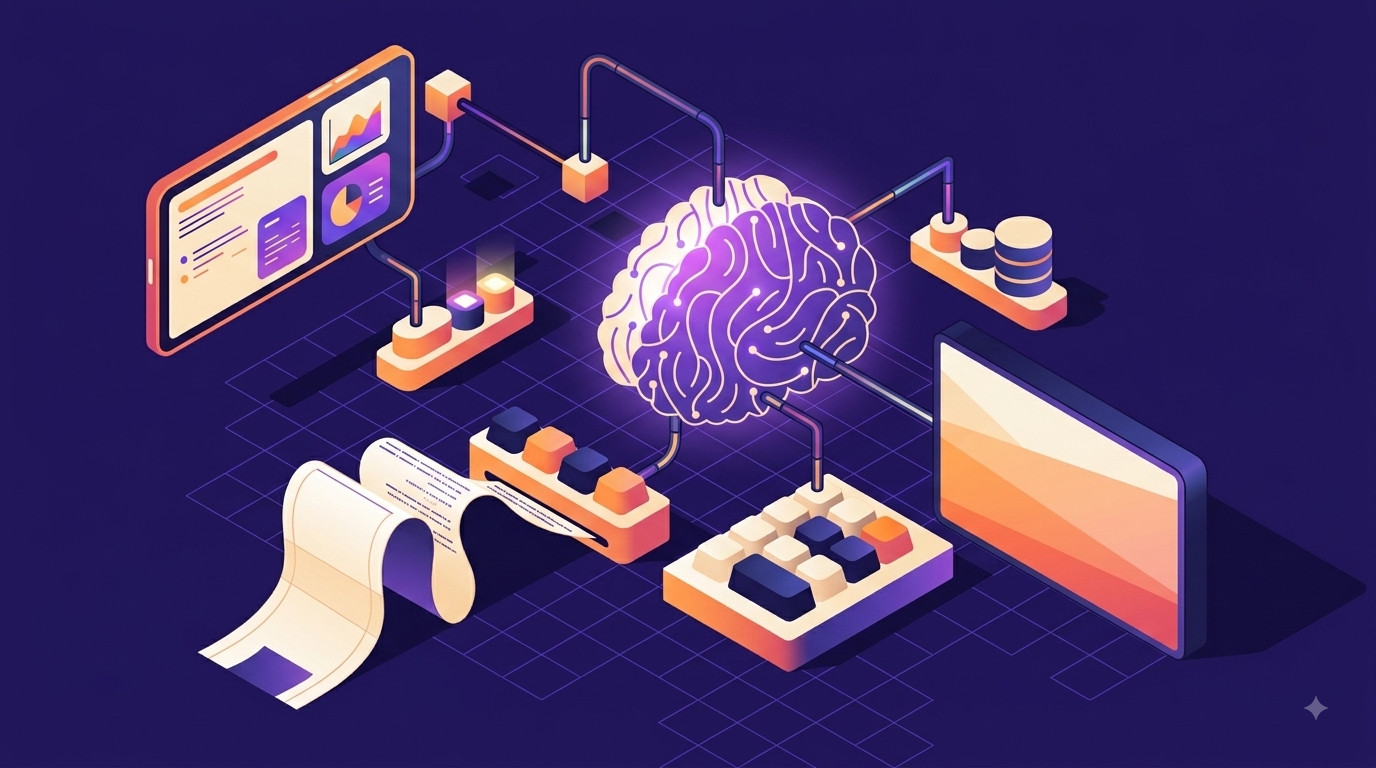
Why the future of AI engineering isn't simple prompt wrappers or drag-and-drop tools, but autonomous, self-healing agentic architectures built right here in Nagaland.
If you have spent any time on tech Twitter or LinkedIn over the past year, you have heard the term thrown around constantly: Agentic AI.
Every enterprise claims to be deploying "agents," and every tutorial claims to show you how to automate your entire life. But when you look under the hood of most bootcamps and workshops, the reality is underwhelming. The vast majority of programs teach basic sequential prompt chains, superficial wrapper scripts, or fragile drag-and-drop no-code recipes.
While no-code automation platforms like n8n or Zapier serve a purpose for simple linear triggers, they break the moment an application needs to reason through non-deterministic errors, write sandboxed code, or coordinate multi-turn state machines.
That changes now.
We launched AI with ia—Nagaland’s first 2-day code-first, systems-level Agentic AI developer workshop, held on 28th and 29th August 2026.
What Makes an Agent Truly "Autonomous"?
A traditional script executes a fixed deterministic pipeline: Step A -> Step B -> Step C. If Step B fails or returns an unexpected payload, the entire execution halts.
A true autonomous agent operates on a dynamic ReAct loop (Reason -> Act -> Observe):
- 1
Reason: The model assesses its objective, evaluates short- and long-term memory, and analyzes the current environment state.
- 2
Act: It selects a programmatic tool from its registry, validates arguments against strict schemas (such as Pydantic or Zod), and executes an external call—querying a database, spinning up a headless browser, or invoking a sandboxed compiler.
- 3
Observe: It ingests the execution output. If the tool returns a stack trace or an unexpected DOM tree, the agent does not crash. It parses the failure, revises its hypothesis, adjusts parameters, and self-corrects autonomously.
+---------------------------------------------+
   |             Goal / User Request             |
   +----------------------+----------------------+
                          |
                          v
         +---------------------------------+
   +---->|            [ REASON ]           |<----+
   |     |    (Analyze State & Memory)     |     |
   |     +----------------+----------------+     |
   |                      |                      |
   |                      v                      |
   |             +-----------------+             |
   |             |     [ ACT ]     |             |
   |             | (Execute Tool)  |             |
   |             +--------+--------+             |
   |                      |                      |
   |                      v                      |
   |             +-----------------+             |
   +-------------|   [ OBSERVE ]   |-------------+
                 | (Parse Output)  |
                 +-----------------+
Building systems that run these cycles reliably in production requires defensive engineering, structured tool routers, memory pruning, and isolated execution guardrails.
What You Will Build: Zero Fluff, Pure Code
In this intensive two-day masterclass (held on 28th and 29th August 2026), participants wrote code, wired up state graphs, and shipped two production-grade agentic architectures from scratch:
1. Autonomous Web Research & Report Synthesizer
2. Auto-Debugging Supervisor Swarm in Docker
Who Is This Built For?
This workshop is engineered specifically for practitioners who want to operate at the cutting edge of AI infrastructure:
The Next Frontier Starts Here
AI is not just about crafting better prompts. It marks a fundamental paradigm shift in how software systems are designed, tested, and deployed.
Whether you are a software developer looking to automate complex engineering operations or an ambitious student aiming to master production-grade AI systems, AI with ia gives you the foundational engineering principles to build it right.
Part 1 Concluded | Part 2 Coming Soon. We are planning for Part 2 in End of September (Date TBA).
Stay tuned for updated curriculum details and advance registrations.

instudia Editorial Team
Academic & Career Team
ISO Certified Skill Institute
Official articles and curriculum guides prepared by instudia faculty and industry mentors in Dimapur.
Relevant Courses at Instudia